


Ironclad is built for collaborative contract workflows and AI-driven legal operations, whereas DocuSign CLM extends the DocuSign e-signature standard into enterprise document generation and routing. Ironclad typically goes live in a few weeks to a couple of months; DocuSign CLM deployments commonly run 6-12 months.
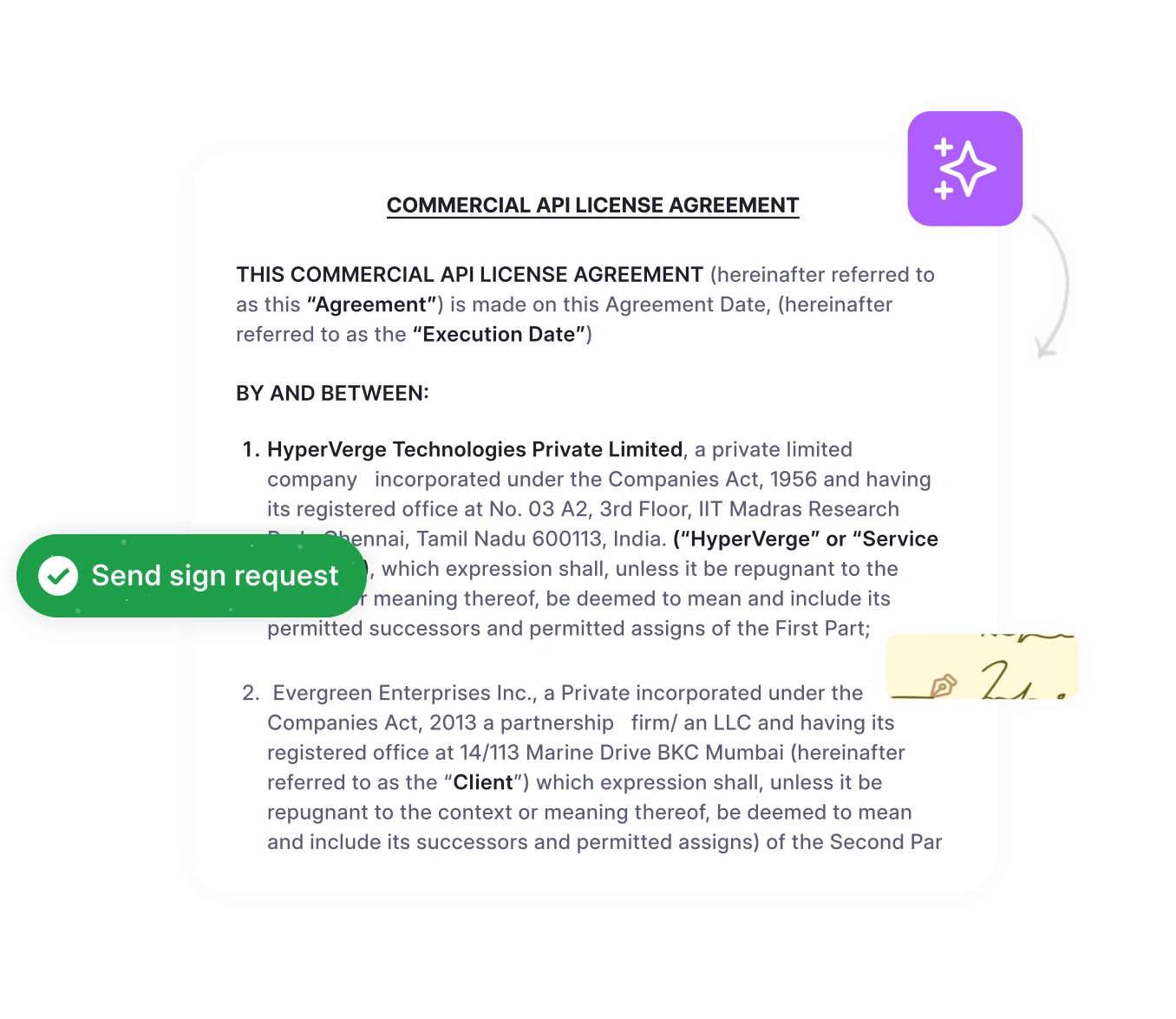
For lower mid-market teams there is a third option: HyperStart is contract lifecycle management (CLM) software from HyperVerge for lower mid-market legal and operations teams. It covers the whole contract lifecycle in one product and goes live in weeks, with no implementation partner—you keep DocuSign for signing and add the contract layer around it.
- Ironclad is built around no-code workflow automation and legal operations; DocuSign CLM extends DocuSign e-signature into document generation and routing.
- Both use custom, quote-based enterprise pricing; third-party benchmarks put Ironclad at $50,000 to $120,000 a year for mid-market (Vendr) and DocuSign CLM at $20,000 to $60,000 a year for 10-25 users (Vendr), each with implementation billed on top.
- Ironclad typically onboards in weeks to a couple of months, while DocuSign CLM deployments commonly run 6-12 months and are frequently consultant-led.
- Ironclad offers its own signature and integrates with DocuSign, Adobe Sign and Dropbox Sign; DocuSign CLM uses native DocuSign e-signature.
- HyperStart is CLM for lower mid-market legal and ops teams that goes live in weeks with no implementation partner and keeps your DocuSign e-signature.
Both Ironclad and DocuSign CLM are built and priced for enterprise, with an implementation project behind them. If you are a two-person legal or ops team that has outgrown a shared drive and a folder of Word templates, the honest question is not “which of these two”—it is “what can actually go live without an integrator and a six-month runway.” This guide answers the comparison straight, then shows where a leaner option fits.
Core differences at a glance
The core difference is the starting point: Ironclad is built around no-code workflow automation, while DocuSign CLM extends DocuSign e-signature into document generation and routing. Each row is a self-contained contrast you can read on its own.
- Starting point & focus—Ironclad is built for collaborative, no-code workflow automation and legal operations with a consumer-grade interface. DocuSign CLM extends the DocuSign e-signature ecosystem into document generation and routing. HyperStart covers the whole lifecycle—intake, templates, approval workflows, redlining, signature, repository, contract families and tracking—in one product a small team runs itself.
- E-signature—DocuSign CLM provides native, built-in DocuSign e-signature with no context-switching. Ironclad integrates with external signing tools (DocuSign, Adobe Sign, Dropbox Sign) and also offers its own Ironclad Signature and Click-to-Accept. HyperStart keeps the DocuSign e-signature you already own and integrates with it, adding the contract layer on top—you do not leave the tool you signed on.
- AI & analytics—Ironclad uses Ironclad AI and its Jurist assistant for redlining, risk-scoring, clause comparison and data extraction. DocuSign CLM relies on DocuSign Insight, Seal Software and Iris models for extraction and analytics. HyperStart’s AI extracts, reviews and redlines on your real contracts, not demo contracts.
- Setup & implementation—Ironclad typically onboards in weeks to a couple of months; DocuSign CLM deployments commonly run 6-12 months and are frequently consultant-led. HyperStart goes live in weeks with no implementation partner, no partner margin and no configuration project.
- Pricing—Both Ironclad and DocuSign CLM use custom, quote-based enterprise pricing anchored in the tens of thousands per year. HyperStart is priced to be reachable for the lower mid-market without an integrator’s margin on top.
What is Ironclad used for?
Ironclad is a contract management platform that automates the contract lifecycle, with a focus on no-code workflow creation and legal operations. It handles a range of workflows—sales agreements, HR agreements and complex NDAs—and was built by legal professionals for legal professionals to reduce contract risk. It publishes no public prices and is sold by quote; third-party benchmarks put mid-market deployments at $50,000 to $120,000 per year, plus a one-time implementation of $10,000 to $75,000+. Ironclad holds 4.4 stars on Capterra.
Capterra ratings cited here were current as of 15 Oct 2026.
Read more about Ironclad competitors and how they compare across pricing, features, and implementation.
What is DocuSign CLM used for?
DocuSign CLM is used to extend DocuSign e-signature into contract creation, agreement workflows and AI-assisted review. Having pioneered e-signature, DocuSign moved into contract management by acquiring SpringCM, Seal Software and, more recently, Lexion. Its 2024 DocuSign IAM (Intelligent Agreement Management) release ties contracting from creation through execution, with AI-powered document preparation, agreement workflows and AI-assisted review. For a buyer comparing it to Ironclad, the CLM sits as a layer wrapped around the signature core—custom-quoted, with deployments typically running $20,000 to $60,000 per year for 10-25 users (Vendr), plus professional services that typically run $5,000 to $50,000+ (Vendr) for implementation.
Best suited for
Ironclad fits mid and large enterprises, DocuSign CLM fits large enterprises already in the DocuSign ecosystem, and HyperStart fits lower mid-market legal and ops teams that have outgrown shared drives.
| Market | Ironclad | DocuSign CLM | HyperStart |
| Who it fits | Mid and large enterprises | Large enterprises already in the DocuSign ecosystem | Lower mid-market legal and ops teams that have outgrown shared drives and Word templates |
At a glance
Both Ironclad and DocuSign CLM are popular with enterprise buyers. For a fast-growing business, the friction shows up in cost, implementation time, support access and day-to-day usability. Here is a bird’s-eye view alongside HyperStart CLM.
| Feature | Ironclad | DocuSign CLM | HyperStart |
| Pricing | Custom quote | Custom quote | Custom quote, implementation included |
| Setup | 4+ weeks | 4+ months | Live in weeks |
| Free trial | Demo (no self-serve trial on pricing page) | Demo via sales for CLM (DocuSign CLM); the 30-day free trial covers eSignature (DocuSign) | 7-day free trial (HyperStart pricing) |
| Support | At extra cost | At extra cost | At no cost |
| Who runs it post-launch | Legal ops + support | Admin + consultant | A two-person legal team |
If you’ve outgrown shared drives and Word templates but can’t run an enterprise CLM
If you can’t run an enterprise CLM, prioritize going live in weeks, a tool a two-person team can run, AI you can test on your own contracts, and early IT sign-off. This is the gap neither Ironclad nor DocuSign CLM is built to fill. Both assume a buyer with budget and an integrator. If that is not you—if you are a new legal or ops hire who inherited a shared drive, a renewal you found out about late, and forty copies of the same NDA—here is what actually matters.
- Go live in weeks, not quarters. No systems integrator, no partner margin, no configuration project. You work directly with the people who build the product, before, during and after.
- A two-person team can run it. Workflows and templates you change yourself, without a ticket or a consultant—so a small team runs what used to take six.
- AI you can trust on your own contracts. Run it on ten of your real contracts and judge the extraction, review and redlining yourself—not on a demo set.
- IT sign-off happens early. Because HyperStart is SOC 2 Type 2 and ISO 27001 certified, and HIPAA compliant, your security questionnaire is covered before it is raised.
See how HyperStart runs the whole lifecycle for a lean legal team—book a demo.
Ironclad vs DocuSign CLM: feature comparison
Ironclad is stronger on no-code workflows and adoption once live, while DocuSign CLM is stronger on native e-signature. Below, the two are compared across the ten criteria that decide the fit for a scaling team, with HyperStart alongside for contrast.
1. Pre-sign
The pre-sign stage automates creation, review, approval and redlining, and it works best with configurable workflows and granular controls. Does your in-house legal team struggle to identify and track approvals for high-risk deals, or lack visibility into the pre-execution process?
Ironclad
Ironclad’s Workflow Designer uses a drag-and-drop, no-code builder to standardize workflows—create, launch, monitor and agree on contracts without chasing approvals by hand. Ironclad now offers native DOCX editing within its browser-based platform, though there is no dedicated Microsoft Word plugin, so users work inside Ironclad’s own editor. Users note that notifications go to one person at a time, which makes sequential or multiple ad-hoc approvals harder to automate.
Ironclad is a great tool for your most commonly executed Agreements—NDAs, MSAs, Service Orders, etc. Our organization has had great success implementing these workflows with minimal negative feedback.

not able to assign multiple people to receive the contract, can only assign it to one email address, cannot CC. this can get tricky when contract review is needed by multiple people
DocuSign CLM
DocuSign CLM is the gold standard for e-signature, with pre-signature functionality built out later to complete the platform. Users report that templates are limited with inadequate conditional rules, that configuring workflows often needs support, and that redlining and external review burn time.
I’d like there to be a way where you can drag and line up templates as you please instead of having to add them to a favorites folder or to cut and paste them in the order that you want them.
HyperStart
HyperStart lets you redline and edit in Word inside the platform, so legal review happens where legal already works. You configure granular controls and approval workflows to fit your governance, and AI review and redlining work on your real contracts. You also get an approval history and AI contract summaries of key contract data, so the contract goes out for signature with confidence.
2. Redlining and editing in Word, inside the platform
HyperStart does the redlining and Word editing inside the platform, while Ironclad edits DOCX in-browser with no Word plugin and DocuSign CLM editing is reported as slow. Lose control at negotiation and you lose the system of record; keeping it inside the platform means each version stays tracked and nothing drifts out of record.
3. Contract families and amendments
A contract rarely stands alone—it has amendments, order forms and renewals hanging off it. A contract family links those together: parent-child relationships, metadata rolled up across the whole family, and amendment tracking so you can see what changed and when. HyperStart links the family automatically and rolls contracted value and dates up across it, which is what Finance and Procurement actually ask for. The fastest test: ask each vendor to show a contract family with three amendments and rolled-up metadata, live, on your own paper.
4. E-signature
DocuSign CLM uses native DocuSign e-signature, Ironclad offers its own signature plus integrations with DocuSign, Adobe Sign and Dropbox Sign, and HyperStart integrates with the DocuSign e-signature you already own. You need to configure, launch and sign compliantly in one place, and you need to know how e-signature works and whether it costs extra.
Ironclad
Ironclad integrates with external signing providers—DocuSign, Adobe Sign and Dropbox Sign—and also offers native Ironclad Signature and Click-to-Accept. You pay only for completed contracts.
DocuSign CLM
DocuSign CLM provides native, built-in DocuSign e-signature with no context-switching, backed by global security standards including ISO 27001, PCI DSS, SSAE 18 (SOC Type 1 and 2), CSA STAR and APEC PRP.
Sometimes E-Signatures are not accepted by other companies so it can make it a bit irrelavent, also names can get hidden if they are too long.
HyperStart
HyperStart keeps the DocuSign e-signature you already own and integrates with it (see the summary above); it also integrates with Adobe Acrobat Sign and Zoho Sign, and offers native OTP-based signing. HyperStart is SOC 2 Type 2 and ISO 27001 certified, and HIPAA compliant.
5. Post-signature
Post-signature, the three differ most on repository search, tagging and reporting. Once contracts are signed, they need to be analyzed, tracked, found on demand and reported on—with strong security, two-factor authentication and encryption for sensitive data.
Ironclad
The Ironclad repository is secure, and its AI is powered by the Jurist assistant for review, redlining and research. Based on Ironclad contract management reviews, users note that search is limited, smart tags need manual back-end updates, and dashboards and reports need manual work.
The capitalization (Lower and Upper) in the Counterparty Name is creating a lot of trouble so will need to clean up … Dashboard is slightly different and have been creating a lot of unnecessary reports.
DocuSign CLM
DocuSign CLM meets enterprise-grade security standards and uses DocuSign Insight, Seal Software and Iris models for extraction and analytics. Users report the repository can function as little more than a digital filing cabinet, with limited tagging and search on some tiers.
Docusign CLM Essentials does not allow you to tag contracts and search contracts by those tags. You are limited only to a number of pre-set contract “types”, which cannot be modified.
HyperStart
HyperStart’s repository analyzes, searches and surfaces value in contracts. Optical Character Recognition makes scanned paper searchable, and smart tags make categorizing and finding information easy. Your sales team can track renewals and obligations without leaving their CRM, and dashboards and reports auto-generate or customize to the scenario.
Need help choosing between Ironclad and DocuSign?
HyperStart simplifies your decision-making process with personalized comparisons and expert guidance.
6. Usability and adoption
Usability differs most in setup effort: Ironclad’s workflows and reports need manual setup, DocuSign CLM users report a steep learning curve, and HyperStart users start working once it is live. A CLM has to be easy to adopt from demo to delivery, with an interface that fits how the team already works.
Ironclad
Ironclad’s workflows, smart tags and reports require manual setup that depends on support, though the support team is responsive and learning resources are plentiful.
The most recent UI changes … generally require users to make more clicks to achieve their goal, and it put the onus on Legal Ops within companies to train their teams.
DocuSign CLM
DocuSign CLM users report a complex interface and a steep learning curve, with several functions needing support and a UX that smaller teams find hard to relate to.
HyperStart
HyperStart users start working the moment the product is live, and the support team is responsive when roadblocks come up.
7. Implementation
Ironclad targets 4-6 weeks, DocuSign CLM setup takes months, and HyperStart goes live in weeks with no implementation partner. The industry norm for implementation is a month or more. Quick intake and setup mean quick time-to-value—and the time, money and data you put in should be proportional to the value you get out.
Ironclad
Ironclad promises major efficiency across the business and detects 194+ contract properties automatically. It targets implementation in 4-6 weeks, though users report the process can be cumbersome and need extra support with high data volumes.
DocuSign CLM
Having set the bar for e-signature, DocuSign worked backward to add contract management through acquisitions, which added friction. Setup takes months and is frequently consultant-led.
Hard to setup, it should be smotth for a layman which i feel is not the case. The tutorials aren’t easy to understand.
HyperStart
HyperStart goes live in weeks with no implementation partner. Here is how one customer described it:
Implementation was very smooth. Using the bulk upload feature, all contracts were integrated into the system within minutes. I was also able to see the AI extracted metadata on the tool immediately, which was impressive.

Mayuri Jaltare
Company Secretary, Qapita
8. Integration
DocuSign CLM connects with 1,000+ tools, Ironclad integrates with Salesforce, HubSpot, Slack and more, and HyperStart integrates with tools including Salesforce and Zoho Sign. Integrations to your enterprise systems and internal tools cut back-and-forth and let people work in their own environment—a sales engineer creating, approving and signing without leaving the CRM.
Ironclad
Ironclad integrates with Salesforce, HubSpot, Coupa, Zip, Microsoft Teams, Slack, Zapier, Dropbox, Box, OneTrust, Formstack and more.
DocuSign CLM
DocuSign CLM connects with 1,000+ tools, though users report issues with some API/SDK calls.
HyperStart
HyperStart integrates with popular tools, including Salesforce and Zoho Sign. The pool is smaller, but you can request specific integrations from the product team directly.
9. Pricing
Both Ironclad and DocuSign CLM use custom, quote-based pricing, with implementation on top. How much does Ironclad cost? Ironclad uses custom, quote-based pricing by team size, contract volume and features; third-party benchmarks (Vendr) put mid-market deployments at $50,000 to $120,000 per year and large enterprise quotes above $200,000 a year (first-year totals often $250,000 to $400,000), plus a one-time implementation of $10,000 to $75,000+ and extra fees for premium support and AI add-ons like Jurist. DocuSign CLM pricing is also quote-based and separate from standard e-signature plans, with extra fees for premium support, advanced features and enterprise integrations.
In both cases, the license is only part of the number—the implementation project sits on top. HyperStart is purpose-built for scaling teams, priced on a custom quote based on users or contract volume, with implementation and contract migration included at no extra cost and no partner margin.
10. Industry and roles
The right CLM has to work for more than legal: the legal-to-stakeholder ratio at many scaling organizations is 1:100 or more.
Ironclad
Users report that Ironclad’s contract AI is thin on functionality for procurement teams.
DocuSign CLM
On account of adoption challenges, users report that not all stakeholders get visibility into contract data and processes, which adds to the tedium.
HyperStart
HyperStart is only as good as the teams it makes capable:
Sales runs standard paper from creation to renewal without leaving the CRM, closing deals faster.
Procurement buys faster and more transparently, with every amendment linked to its agreement and auto-renewal dates visible before the window closes.
Finance reads contracted value, payment terms and escalators rolled up across a contract family, not buried in six PDFs.
HR centralizes and standardizes employee contracts at scale.
User sentiment: what buyers actually report
Across buyer forums, two patterns recur. Enterprise CLM carries heavy setup overhead—the implementation is a project, not a switch-on. And adoption outside legal depends on an interface non-lawyers will actually use. In procurement discussions, DocuSign CLM is often cited for setup overhead, while Ironclad earns praise for user adoption once it is in. For a lean team, the takeaway is simple: the tool that goes live fastest and gets used outside legal is the one that pays off.
Feature comparison: HyperStart vs Ironclad vs DocuSign CLM
The table compares implementation time, redlining, contract families, e-signature, AI and security across HyperStart, Ironclad and DocuSign CLM.
| Feature | HyperStart | Ironclad | DocuSign CLM |
| Implementation time | Live in weeks | 4+ weeks | 4+ months |
| Who runs it post-launch | Two-person legal team | Legal ops + support | Admin + consultant |
| Redlining location | In Word, inside the platform | In-browser DOCX editor, no Word plugin | Editing reported as time-consuming |
| Contract families | Yes—parent-child, metadata rollup | Ask to see a family with three amendments | Ask to see a family with three amendments |
| E-signature | Integrates with DocuSign, Adobe Acrobat Sign, Zoho Sign | Native, plus integrations | Native DocuSign |
| Keeps your DocuSign e-sign | Yes, integrates | Yes, integrates | Yes, native |
| No-code workflows | Yes | Yes | Yes; users report setup often needs support |
| Smart search | Yes | Limited, per G2 users | Limited on Essentials, per G2 users |
| Smart tags | Yes | Manual back-end updates, per G2 users | Preset types only on Essentials, per G2 users |
| Automated dashboards & reports | Yes | Manual, per G2 users | Ask to see your reports built live |
| AI redlining & review | Yes—reliable on real contracts | Yes (Ironclad AI, Jurist) | Yes (DocuSign Insight, Iris) |
| Security certifications | SOC 2 Type 2, ISO 27001 (certified); HIPAA compliant | SOC 1 and SOC 2 Type II reports; GDPR and HIPAA compliance | ISO 27001, SOC 1 & 2, PCI DSS |
While each of these is a strong choice, HyperStart is an alternative to Ironclad and an alternative to DocuSign CLM worth weighing for lower mid-market and scaling teams—one that keeps your DocuSign e-signature and integrates with it.
How to choose: four questions to answer first
Choose by answering four questions—contract volume, existing e-signature, team size and primary department—before you request demos; they decide the fit faster than any feature list:
- Contract volume—how many contracts a month, and how many are routine (NDAs, standard orders, renewals) versus negotiated?
- Existing e-signature—are you already on DocuSign or Adobe Sign? If so, ask yourself: are you buying DocuSign’s CLM, or do you already have e-signature and need the layer around it? Either way, you want a CLM that keeps your signature tool, not one that replaces it.
- Team size—who runs the CLM day to day, and who owns configuration after go-live? Ironclad is the category leader for a legal ops team of ten; if you have two, a consultant-led platform will stall.
- Primary department—is the driver legal, ops, sales or procurement? Adoption depends on the tool fitting that team’s existing workflow.
When you get quotes, ask each vendor for implementation as a separate line from the license. Then run your shortlist on ten of your own contracts, not a demo set. If HyperStart is on it, send us those ten and we’ll build them in, with implementation included in the quote. Book a demo. If you are also weighing other options, see our comparison of Ironclad vs LinkSquares or the best contract management software for your team.
DocuSign CLM vs Ironclad: Which is better?
Make your CLM purchase thoughtful, responsible, and inclusive.